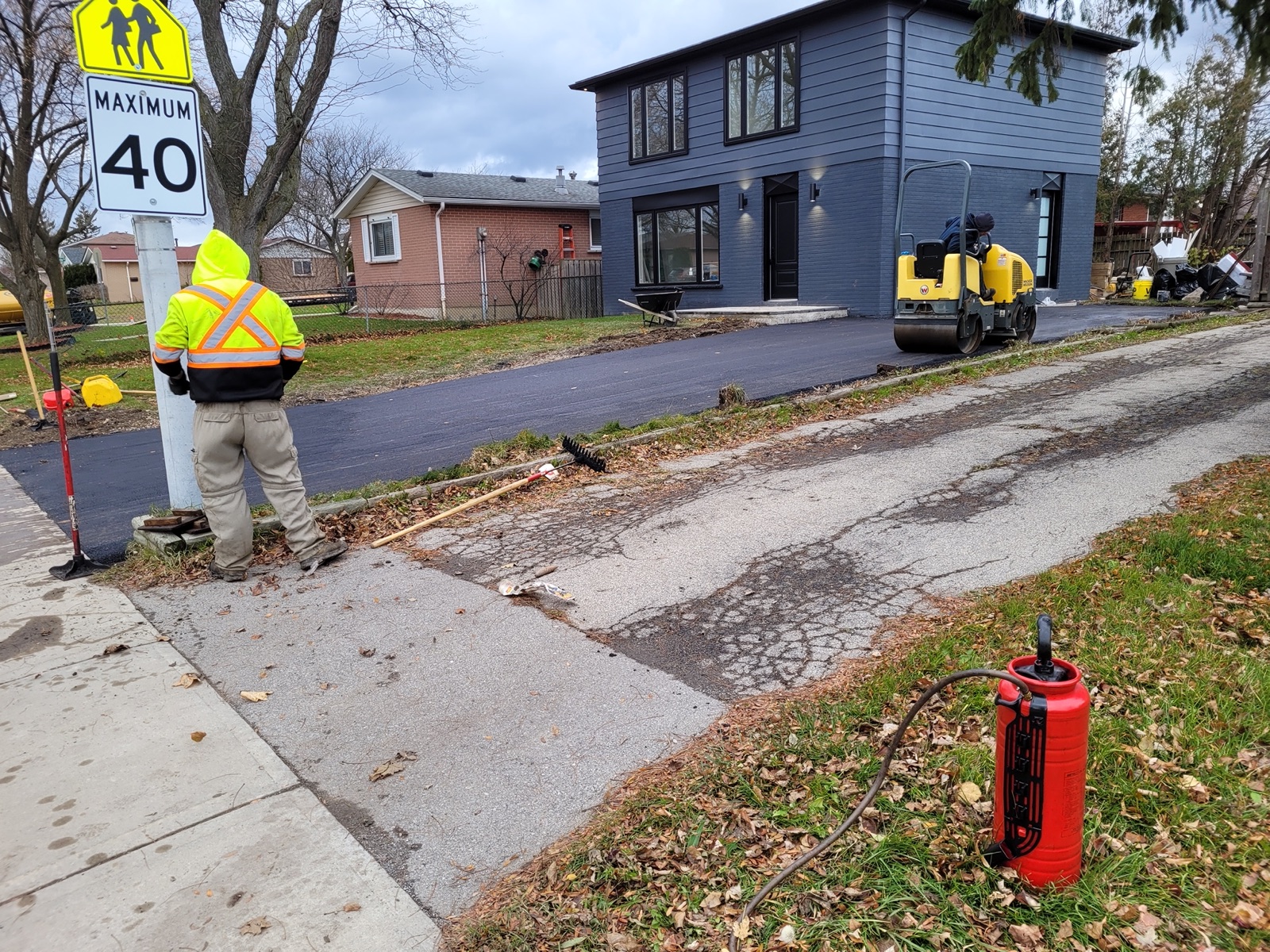
If you've ever wondered what actually goes into a new asphalt driveway — beyond the crew showing up with a paver — this guide is for you. As Hamilton's experienced paving contractors, we get asked the same questions constantly: How deep do you dig? What's in the base? Why does it matter if it's rolled properly?
The short answer: every step in the process has a direct impact on how long your driveway lasts and how good it looks. Here's the full picture, from first shovel to final roll.
Why the Process Matters More Than the Asphalt Mix
Many homeowners assume that the quality of an asphalt job comes down to the asphalt mix itself. In reality, the mix accounts for maybe 20% of long-term driveway performance. The other 80% comes from what's underneath — the sub-base preparation, compaction quality, and drainage design. A great asphalt mix laid over a poor base will fail within 5–7 years. A standard mix laid over a properly prepared base can last 25–30 years.
Step 1: Free Estimate & Project Planning
Before any work begins, a qualified estimator visits your property. They'll measure the area, assess the existing surface conditions, identify drainage patterns, and discuss what you're looking for. You'll get a detailed written quote — materials, labour, scope, and timeline — within 48 hours. There should be no vague line items or verbal promises. Get everything in writing.
At this stage, we also plan the finished grade — how the driveway will slope to carry water away from your home's foundation. For most driveways, a 1.5–2% cross-slope toward the street is ideal.
Step 2: Demolition & Removal of Old Pavement
If you're replacing an existing driveway, it needs to come out. We use skid steers with breakout attachments, jackhammers, and excavating equipment to break up and remove the old material. All demolished asphalt and concrete is loaded and hauled off-site.
Good news for the environmentally conscious: old asphalt is the most recycled material in North America by weight. It gets crushed and blended back into new hot-mix at asphalt plants — nothing goes to the landfill.
Step 3: Subgrade Excavation & Shaping
With the old surface removed, we excavate to the required depth — typically 8–12 inches total for a residential driveway in Ontario's climate. The native soil (subgrade) is then shaped and graded with a skid steer or compact excavator to establish the correct slope profile.
If we encounter soft spots — areas where the ground feels spongy or doesn't compact well — those zones are over-excavated and backfilled with stable granular material. Soft subgrade is one of the most common causes of premature driveway failure, and it needs to be addressed at this stage, not covered over.
Step 4: Granular Sub-Base Installation & Compaction
This is the most critical step in the entire process. A minimum 6-inch layer of Granular A (crushed, well-graded stone) is spread across the excavated area in layers (lifts) and compacted using a vibratory roller or plate compactor after each lift.
The sub-base does three things:
- Distributes vehicle loads evenly to the subgrade below
- Provides a stable, non-erodible platform for the asphalt
- Allows drainage away from the pavement structure
Never let a contractor skip the sub-base, thin it out to save money, or fail to compact it properly. This is where corners are cut — and where driveways fail early.
Step 5: Edge Preparation & Forming
Driveway edges are defined precisely using string lines, stakes, or forms. Transitions to your garage floor slab, the public sidewalk, and the street curb are carefully planned to ensure seamless, correct-elevation connections. A sloppy edge transition is an eyesore and can trap water — we take extra care here with hand-raking and precise forming.
Step 6: Hot-Mix Asphalt Paving
This is the part everyone pictures. Fresh hot-mix asphalt — delivered at 140–165°C directly from a certified Ontario plant — arrives by dump truck and is transferred into an asphalt paver. The paver spreads and partially levels the material at the specified depth across the prepared base.
For residential driveways, we typically apply 2.5 to 3 inches of compacted asphalt. Raking crews hand-finish edges, curves, around catch basins, and tight areas that the paver can't reach precisely. Timing is critical — asphalt must be placed and compacted before it cools below about 115°C.
Step 7: Rolling & Compaction
Immediately after paving, steel drum rollers compact the asphalt from the outside edges inward to the centre. Multiple passes are made, and our operator watches the asphalt closely — proper density is achieved at a specific temperature window. Compacting too early or too late both cause problems.
The target density is minimum 92% of maximum theoretical density (MTD) — industry standard for residential asphalt. We use a nuclear density gauge to spot-check critical areas. Edges are rolled carefully to prevent crumbling, and any areas that need touch-ups are hand-raked and compacted before the material cools.
Step 8: Final Inspection & Cleanup
Our foreman walks the finished driveway with you, checking for uniformity, slope, and surface quality. All equipment, excess material, and debris are removed. We advise on cure time:
- 24–48 hours before driving a passenger vehicle on it
- 30 days before parking a heavy vehicle or making sharp turns on a hot day
- 6–12 months before applying the first sealcoat
What About Sealing?
A new driveway doesn't need sealing right away — it actually needs time to cure and off-gas. The first seal coat should be applied 6–12 months after installation, and then every 2–3 years after that. Sealing protects the asphalt from UV degradation, water penetration, and oil/fuel damage — significantly extending the pavement's lifespan.
Learn more about our sealing service →
How Long Will My Driveway Last?
With a properly built base and regular maintenance (sealing every 2–3 years, crack filling as needed), an asphalt driveway in Hamilton's climate should comfortably last 20–30 years. The number one killer of asphalt driveways is water infiltration — water gets into cracks, freezes, expands, and breaks the pavement apart from within. Keep cracks sealed, and you keep water out.
Ready for a New Driveway?
We've been paving driveways in Hamilton and surrounding communities for over 8 years. Contact us for a free, no-obligation estimate — we'll come out, measure the site, and have a written quote to you within 48 hours.
Get a Free Estimate Driveway Paving Service